


In May 2025, South Asia came dangerously close to a wider military conflict between two nuclear-armed neighbours.
For four days, India and Pakistan exchanged military strikes, accusations and warnings in a confrontation that alarmed the international community and threatened regional stability.
The crisis was one of the most consequential tests of General Syed Asim Munir's tenure as Pakistan's Chief of Army Staff.
It demanded military preparedness, operational coordination and the ability to manage escalation under intense political and international pressure.
The confrontation also became a turning point in his career.
Within days of the ceasefire, Pakistan's government would approve his promotion to the rank of Field Marshal, an exceptional military distinction previously awarded in Pakistan only to Muhammad Ayub Khan.
Yet beyond individual recognition, the events of May 2025 raised a larger question.
Could India and Pakistan continue relying on military deterrence and crisis diplomacy to prevent war, or would the absence of sustained political dialogue eventually produce a confrontation neither side could control?
To understand Munir's role, it is necessary to examine the events that brought the two countries to the brink.
The Pahalgam attack: The crisis begins
On April 22, 2025, gunmen attacked tourists near Pahalgam in Indian-administered Kashmir, killing 26 people.
The attack caused widespread outrage in India and drew international condemnation.
New Delhi accused Pakistan of involvement in cross-border terrorism.
Islamabad rejected the allegations and called for an independent and credible investigation.
The competing positions rapidly hardened.
India announced punitive diplomatic measures, including placing the Indus Waters Treaty in abeyance.
Pakistan responded with its own restrictions and warned that any attempt to stop or divert waters allocated to Pakistan under the treaty would be treated as an extremely serious threat.
Diplomatic relations deteriorated.
Airspace restrictions, border tensions and inflammatory public statements increased the risk of confrontation.
For Munir, the situation presented a familiar but exceptionally dangerous challenge.
Pakistan had to prepare for possible military action while avoiding steps that could trigger an uncontrolled conflict.
The difficulty was compounded by the speed with which the crisis was developing.
Both countries possessed substantial conventional military capabilities.
Both were nuclear powers.
And both faced strong domestic pressure to demonstrate resolve.
Operation Sindoor: India launches military strikes
During the night of May 6-7, India launched Operation Sindoor, striking locations in Pakistan and Pakistan-administered Kashmir.
Indian authorities described the operation as a targeted response against what they identified as terrorist infrastructure connected to the Pahalgam attack.
Pakistan rejected India's characterisation of the targets, reporting civilian casualties and damage to residential areas and religious buildings.
The strikes marked a major escalation.
For the first time in the crisis, the confrontation had moved from diplomatic retaliation and military warnings to direct armed action.
Pakistan's military responded with air-defence operations and other military measures.
The Pakistan Air Force and Indian Air Force became central to the developing confrontation.
Both governments issued statements describing their operations and asserting military successes.
However, many battlefield claims remained contested, particularly regarding the number of aircraft lost, the damage inflicted on military installations and the precise results of individual engagements.
For responsible historical assessment, it is essential to distinguish official claims from independently established facts.
The confrontation demonstrated that both countries possessed the capacity to conduct significant military operations across their borders.
It also showed how quickly limited strikes could create the possibility of a wider war.
May 8-9: The danger of escalation
During the following two days, the conflict expanded into exchanges involving drones, missiles, artillery and air-defence systems.
Both sides accused the other of targeting military facilities and civilian areas.
Communities near the Line of Control suffered casualties, displacement and disruption.
Flights were suspended or diverted, airports faced restrictions, and residents of vulnerable border districts were forced to seek safety.
The conflict also revealed how modern technology was changing warfare in South Asia.
Drones, precision-guided weapons, electronic warfare and long-range strike capabilities played important roles.
Military planners on both sides were operating under the constant danger that a tactical decision could produce consequences far beyond the immediate battlefield.
An assessment published by the Stimson Center later concluded that the fighting had crossed several previous thresholds in the India-Pakistan rivalry, particularly in the geographic reach of strikes and the employment of new weapons systems.
It also cautioned that misinformation and conflicting official accounts complicated efforts to establish a complete picture of the fighting.
Stimson Center
May 10: Pakistan launches Operation Bunyan-un-Marsoos
On May 10, following further Indian strikes against Pakistani military facilities, Pakistan announced Operation Bunyan-un-Marsoos, its major retaliatory military operation.
Pakistan's armed forces said they had targeted Indian military installations and other strategic facilities in response to Indian attacks.
India acknowledged damage at some military installations but disputed Pakistan's broader claims concerning the scale and effectiveness of the strikes.
Both countries continued to describe their actions as defensive and justified.
The military confrontation had now reached a dangerous stage.
Each side wanted to demonstrate that it could impose costs on the other.
Yet neither could be certain how the opposing leadership would interpret further attacks.
For Munir, this was the defining operational challenge of the crisis.
As Chief of Army Staff, he was responsible for army preparedness and command within Pakistan's wider military response, coordinated with the air force, navy and civilian leadership.
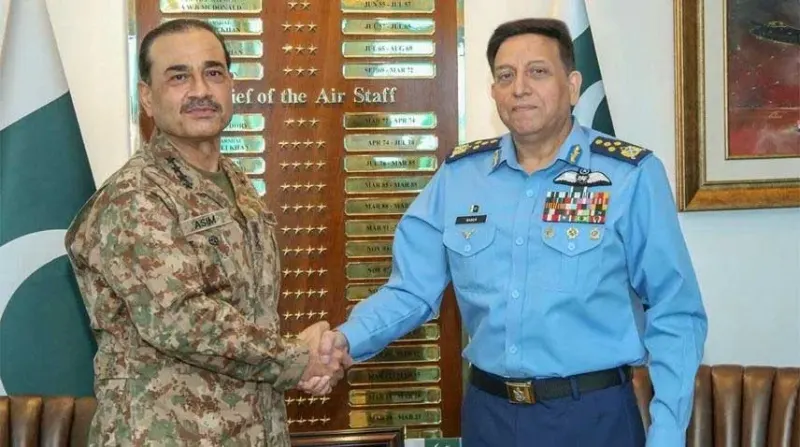
The Pakistan Air Force, under Air Chief Marshal Zaheer Ahmed Babar Sidhu, played a central role in aerial operations.
The outcome could not reasonably be attributed to one individual or one service.
It reflected decisions across Pakistan's military command structure, just as the wider crisis involved political and diplomatic calculations by both governments.
The air battle and competing claims of victory
One of the most heavily debated aspects of the confrontation concerned aircraft losses.
Pakistan initially claimed that its forces had shot down five Indian fighter aircraft, including Rafale jets.
India disputed Pakistan's account of the losses.
Subsequent independent assessments indicated that India had likely lost multiple aircraft during the opening phase of the fighting, although the precise number and circumstances remained disputed.
The Stimson Center's assessment also found evidence of Indian long-range strike capabilities and noted the limited independently observable damage inflicted on Indian military facilities by Pakistani attacks.
These findings illustrate why the confrontation cannot be reduced to a single, uncontested military scorecard.
Both governments declared success.
Pakistan emphasised its response to Indian strikes and its ability to defend national sovereignty.
India emphasised its ability to strike targets inside Pakistan and its declared objective of responding to terrorism.
Military success, however, is not measured only by aircraft losses or damage to installations.
It also involves whether political objectives were achieved, whether escalation was controlled and whether national security was strengthened in the longer term.
On those questions, the consequences of the confrontation remain open to historical assessment.
Stimson Center
Washington intervenes: The ceasefire of May 10
As the conflict intensified, international diplomatic efforts accelerated.
The United States became particularly active.
President Donald Trump announced on May 10 that India and Pakistan had agreed to an immediate ceasefire following American diplomatic engagement.
US Secretary of State Marco Rubio also acknowledged intensive discussions with senior officials from both countries.
Pakistan welcomed Washington's role in helping bring the confrontation to an end.
India confirmed the ceasefire but maintained that the understanding had been reached through direct communication between the two countries' military authorities, rather than formal third-party mediation.
The distinction remained politically significant.
Pakistan has generally supported international diplomatic involvement in reducing tensions over Kashmir.
India has traditionally insisted that its disputes with Pakistan should be handled bilaterally.
Despite these differences, the immediate outcome was clear.
The two militaries agreed to halt hostilities on May 10.
The ceasefire was initially fragile, with accusations of violations, but the most intense fighting subsided.
The agreement demonstrated the importance of diplomatic communication even during a rapidly escalating military confrontation.
It also revealed the continuing international concern over the possibility of war between nuclear-armed neighbours.
Every CRS Report+1
Munir's leadership under examination
For General Asim Munir, the May confrontation represented the most significant conventional military crisis since he became Army Chief.
His earlier responsibilities had concentrated heavily on counterterrorism, internal security, border management and institutional reform.
The conflict with India required a different set of priorities.
Conventional military readiness had to be tested.
Coordination among the armed services became essential.
Political and military decision-making had to remain aligned.
And military operations had to be considered against the danger of uncontrolled escalation.
Pakistan's government publicly praised Munir's leadership, describing the military response as a major national achievement.
The confrontation also produced a surge of patriotic sentiment across Pakistan, where the armed forces were widely celebrated for their performance.
Nevertheless, a comprehensive assessment must recognise the contributions of the Pakistan Air Force, Navy, intelligence organisations, civilian authorities and diplomatic institutions.
The crisis was managed through a combination of military action and political decisions, followed by diplomacy.
Its most important result was not simply that both countries claimed victory.
It was that the confrontation ended before becoming a prolonged war.
May 20: A historic decision
Ten days after the ceasefire, Prime Minister Shehbaz Sharif's government announced an extraordinary decision.
On May 20, 2025, the federal cabinet approved the promotion of General Syed Asim Munir to the rank of Field Marshal.
The government cited his military leadership during the confrontation and his role in safeguarding Pakistan's sovereignty and territorial integrity.
The distinction was exceptionally rare.
Pakistan's only previous Field Marshal had been Muhammad Ayub Khan, who received the rank in 1959.
Munir's promotion therefore placed him in a unique position in the country's military history.
He accepted the honour while dedicating it to the armed forces, veterans, martyrs and the Pakistani nation.
The promotion was celebrated by the government and its supporters as recognition of military leadership during a national-security crisis.
Some analysts, however, questioned whether it might further consolidate the military's institutional influence within Pakistan's political system.
Both perspectives became part of the debate surrounding the decision.
Dawn+1
The lessons of May 2025
The four-day confrontation offered several lessons for Pakistan, India and the wider international community.
First, the danger of escalation between nuclear-armed neighbours remains exceptionally high.
Second, modern military technology can compress decision-making time and increase uncertainty.
Third, information warfare can complicate public understanding of battlefield events, particularly when official claims are not independently verified.
Fourth, terrorism and unresolved political disputes can rapidly destabilise bilateral relations.
Finally, diplomacy remains indispensable even when military deterrence appears effective.
Pakistan and India emerged from the confrontation with competing accounts of success.
But both also faced the same enduring reality: geography, nuclear deterrence and regional economic interests make permanent confrontation an extremely costly proposition.
The ceasefire did not resolve the Kashmir dispute.
It did not eliminate the threat of terrorism.
Nor did it establish a comprehensive mechanism for preventing future crises.
Those unresolved issues remained.
From battlefield recognition to international diplomacy
For Asim Munir, May 2025 was a turning point.
He entered the confrontation as Pakistan's Chief of Army Staff.
He emerged from it with the country's highest military rank and an elevated public profile.
His subsequent international engagements, including contacts with the leadership of the United States, China and Gulf countries, would take place against the background of the confrontation and his new status.
Yet military recognition and statesmanship are not identical.
The former is associated with command, operational performance and national defence.
The latter requires sustained judgment, diplomatic restraint and the ability to contribute to political solutions.
The May crisis therefore represented both a culmination and a beginning.
It brought Munir unprecedented recognition within Pakistan's military establishment.
But it also raised expectations concerning his role in preserving national security and contributing to regional stability.
The larger challenge was whether the lessons of a dangerous confrontation could encourage a more durable commitment to peace.
For two countries that had repeatedly experienced military crises, preventing the next war would ultimately matter more than celebrating the last confrontation.