
SHENZHEN: The leaders of the United States, China, and Russia convened for an unprecedented three-way summit in southern China on Thursday, a closed-door session that US President Donald Trump declared was "making history" even as critics warned of its geopolitical optics.
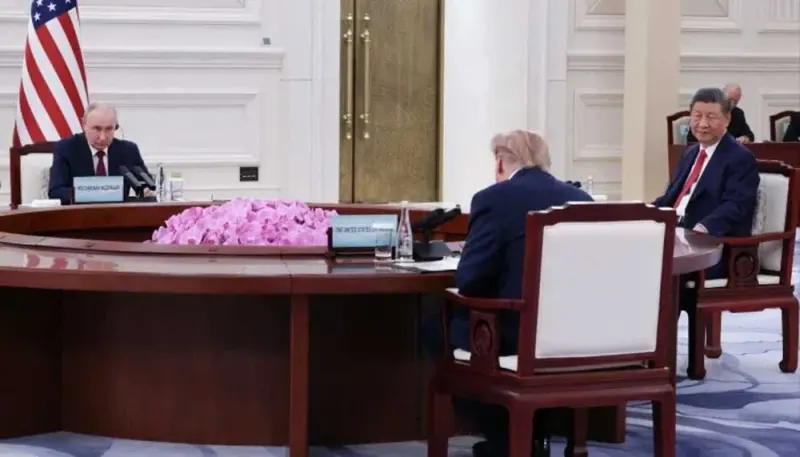
Meeting on the sidelines of the Asia-Pacific Economic Cooperation (APEC) forum at Kylin Villa in Shenzhen, Trump, Chinese President Xi Jinping, and Russian President Vladimir Putin held discussions for an hour and 20 minutes around a large, dark round table adorned with a pink flower arrangement.
In opening remarks covering issues ranging from nuclear arms to the war in Ukraine, Trump welcomed the first-ever trilateral gathering between the three powers. "I'm delighted that this trip has also given us the opportunity for this first ever trilateral meeting between the leaders of the United States, Russia and China," Trump said. "So in that sense, and I think in lots of other ways, we are really making history."
Xi urged his counterparts to "jointly safeguard world peace and stability," while Putin emphasized overlapping interests in ending regional crises—specifically citing the Russia-Ukraine conflict, which is nearing its fifth year. "Our countries have many converging interests when it comes to resolving regional conflicts, including, of course, the conflict in Ukraine," Putin said, adding that the three nations bear a "shared responsibility for maintaining international peace and security." Putin also noted that talks would address food and energy security, both severely disrupted by conflicts in Ukraine and Iran.
Analysts have suggested the summit carries more symbolic weight than immediate policy breakthroughs, and the gathering has drawn both international alarm and skepticism—particularly over fears that the three leaders could carve out global spheres of influence and negotiate Ukraine's fate without Kyiv or Europe at the table.
Critics in Washington sharply questioned the summit's optics for the US president. Lyle Morris of the Asia Society Policy Institute noted that the meeting "gives Putin a platform to legitimise his war of aggression over Ukraine with seemingly little repercussions," while Senate Democratic leader Chuck Schumer stated, "Xi Jinping and Vladimir Putin are playing Donald Trump like a cheap violin."
Bilateral Meetings and Diverging Agendas The trilateral session followed a flurry of one-on-one diplomacy:
- Trump and Putin: Meeting for the first time since August 2025, the 80-year-old US president greeted the 74-year-old Russian leader as his "friend," prompting Putin to reply in English, "Nice to meet you."
- Trump and Xi: Convening for their third bilateral meeting this year, Trump highlighted their "very special relationship," stating afterward that both Washington and Beijing were "looking to both help with respect to the war with Russia and Ukraine."
- Xi and Putin: Xi, 73, and Putin met on Wednesday for what the Chinese president noted was their 50th encounter.
Washington, Beijing, and Moscow offered varying accounts of the summit's agenda. While the US initially indicated Ukraine would not be discussed, Trump later confirmed it was on the table, even though Beijing does not view the war as its responsibility to resolve. China's foreign ministry framed the talks around "in-depth exchanges on safeguarding world peace and promoting strategic stability in major-power relations." Meanwhile, Trump faces domestic and global pressure over the US war with Iran, which has choked oil supplies and driven up consumer prices, while Beijing seeks to bolster its influence in East Asia.
Nuclear Disarmament and Airport Protocol Nuclear arms control also featured prominently following the expiration of a bilateral US-Russia atomic weapons treaty in February. "As the world's three largest nuclear powers by far, the United States, Russia and China are uniquely positioned to discuss how to reduce the number of nuclear weapons on Earth and also to lessen the risk that those weapons will ever be used," Trump said. Beijing, however, has consistently insisted that Washington and Moscow must drastically shrink their larger arsenals before China joins disarmament talks.
Earlier, Xi broke with decades of Chinese diplomatic protocol by personally greeting Trump at the Shenzhen airport. The two briefly hugged before a red-carpet ceremony featuring cheering children and an air force flyover—reciprocating the welcome Trump gave Xi at Joint Base Andrews in September. "It's a friendship relationship. It's a respect relationship," Trump told Fox News.