Pervaiz Mughal
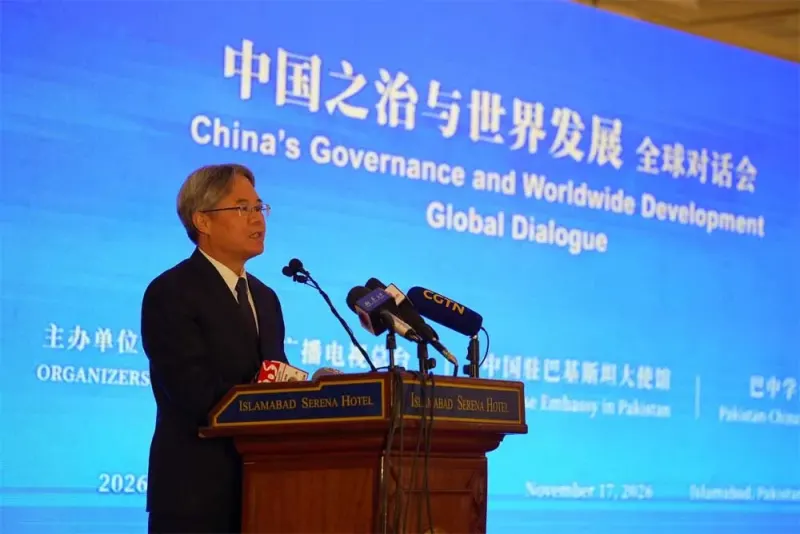
ISLAMABAD: The role of China's governance model in promoting economic and social development, strengthening global governance and advancing international cooperation was highlighted at the "China's Governance and Worldwide Development Global Dialogue" held in Islamabad on Tuesday.
The event was jointly organised by the Chinese Embassy in Pakistan, the Pakistan-China Institute (PCI) and China Media Group (CMG), bringing together political leaders and representatives from Pakistan and China to discuss China's governance experience and its implications for global development.
Executive Director of the Pakistan-China Institute Mustafa Hyder Sayed delivered the opening remarks, followed by an address by China Media Group President Shen Haixiong. Chairman of the Pakistan-China Institute Senator Mushahid Hussain Sayed also delivered a video message, while Chinese Ambassador to Pakistan Jiang Zaidong and Federal Minister Qaiser Ahmed Sheikh addressed the gathering.
In his remarks, Senator Mushahid Hussain Sayed discussed China's governance experience in three broader contexts: people-centred development and Party self-reform, global governance, and the spirit of the Long March.
Referring to the Fifth Plenary Session of the 20th Central Committee of the Communist Party of China (CPC), he highlighted the importance of strict Party self-discipline and continuous institutional reform, describing people-centred governance as an institutional arrangement rather than merely an abstract concept.
He referred to President Xi Jinping's emphasis on the principle of "from the masses, to the masses" and shared his experience of visiting China's Fujian and Ningxia regions last summer. He cited the development partnership between the two provinces, through which the relatively prosperous coastal province of Fujian provided financial and technical support to Ningxia, helping improve livelihoods and reduce poverty.
Turning to international affairs, Mushahid Hussain highlighted President Xi Jinping's Global Governance Initiative, which he said emphasises the central role of the United Nations, multilateralism, international rule of law and sovereign equality in building a more stable international order.
He also referred to the anniversary of the Long March, saying its spirit continues to guide China's modernisation journey.
"Every generation has its own Long March," he said, describing its enduring values as persistence, patience, perseverance and a determination never to give up.
Linking China's governance experience to Pakistan-China relations, he emphasised that bilateral cooperation should focus on practical benefits for the people of Pakistan.
He pointed to several emerging areas of cooperation, including Pakistan's participation in China's space programme, noting that Pakistani astronauts are being trained in China. He also highlighted educational cooperation, stating that more than 30,000 Pakistani students are currently studying in China, including around 8,000 pursuing PhD programmes.
Mushahid Hussain further identified mining, mineral processing and refining as important areas for expanding bilateral economic cooperation, saying that developing Pakistan's capacity to process and export minerals could help generate foreign exchange and create new economic opportunities.
Referring to public perceptions of China's development, he cited international survey findings on Chinese citizens' satisfaction with their country's governance and development model.
Addressing the dialogue, Chinese Ambassador Jiang Zaidong discussed the outcomes of the Fifth Plenary Session of the 20th CPC Central Committee, particularly its resolution on advancing full and rigorous Party self-governance.
He said General Secretary Xi Jinping had delivered an important address at the plenary session and that the CPC was studying and implementing its guiding principles to strengthen Party governance and advance Chinese modernisation.
The ambassador highlighted the importance of building a stronger Communist Party of China, sustaining the country's achievements in economic growth and social stability, and contributing to global political party governance.
He said China's experience offered valuable lessons for other countries while emphasising that the country's development approach remained centred on improving people's lives.
Referring to the two countries' longstanding relationship, Jiang described Pakistan and China as ironclad friends and all-weather strategic cooperative partners, adding that their high-level mutual trust provided a strong foundation for further cooperation.
He said the China-Pakistan Economic Corridor (CPEC), as a pioneering project under the Belt and Road Initiative, would continue contributing to economic progress and prosperity in Pakistan.
He added that China's development and Pakistan-China relations were closely connected, expressing confidence that progresske m in China would create further opportunities for bilateral cooperation.