THE LEADERSHIP SERIES / PART VIII
Field Marshal Asim Munir: From soldier to statesman
Part VIII-Pakistan and China: Asim Munir and the Challenge of Protecting an Iron Brotherhood
Analysis of Gen Asim Munir's approach to protect Chinese workers, secure CPEC projects and uphold Pakistan-China strategic ties amid security threats.
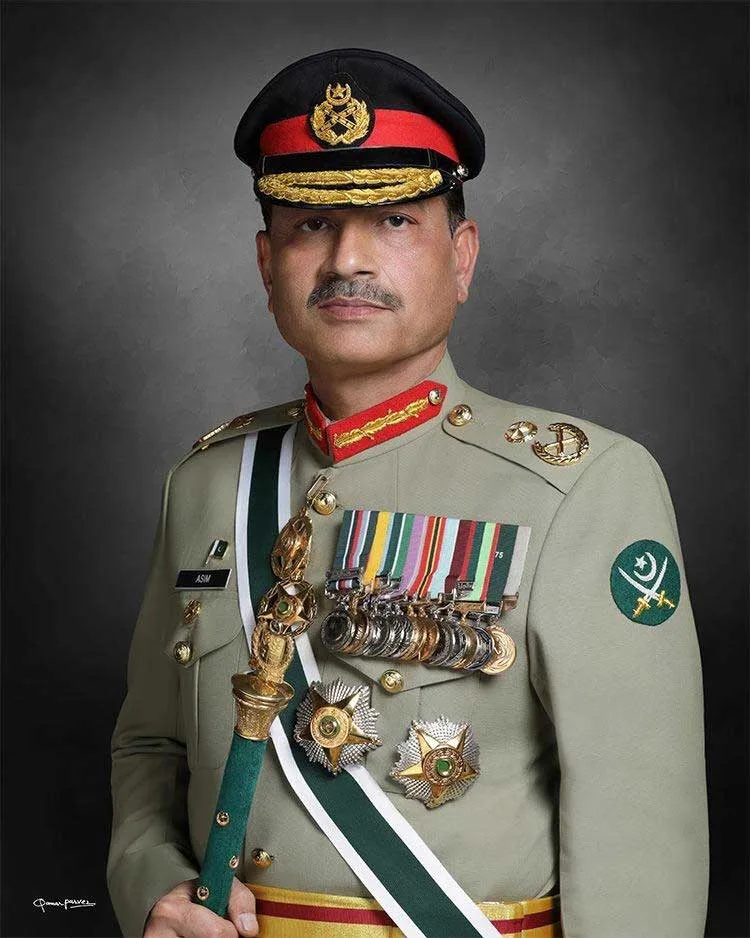

The partnership
in context.
THE FULL PERSPECTIVE / PART VIII
A partnership. Its pressures. The practical test.
Seven chapters on Pakistan–China relations, CPEC and the challenge of protecting an enduring strategic partnership.
01 / THE PARTNERSHIP
An iron brotherhood under pressure
When General Syed Asim Munir assumed command of the Pakistan Army in November 2022, one of the most important relationships requiring his attention was Pakistan's enduring strategic partnership with China.
For more than seven decades, Islamabad and Beijing had maintained a relationship that survived regional conflicts, international political changes and shifting global alliances.
It was a friendship frequently described as higher than the mountains, deeper than the oceans and sweeter than honey.
But by the time Munir became Army Chief, that historic relationship was facing a new generation of challenges.
The China-Pakistan Economic Corridor (CPEC), once celebrated primarily as a symbol of economic transformation, had also become a major security responsibility. Chinese engineers, technicians and workers were contributing to infrastructure, energy and development projects across Pakistan, but terrorist attacks had exposed serious vulnerabilities.
China expected Pakistan to protect its citizens and investments.
Pakistan needed China not only as a defence partner but also as a source of investment, technology, infrastructure development and diplomatic support.
For Munir, therefore, the relationship with Beijing required more than traditional military diplomacy.
It demanded a coordinated approach combining strategic cooperation, counterterrorism, economic security and sustained political engagement.
The challenge was to ensure that Pakistan's celebrated iron brotherhood with China remained equally strong in practical cooperation and mutual confidence.
A partnership built across generations
Pakistan was among the earliest countries to recognise the People's Republic of China, and diplomatic relations were established in May 1951.
Over subsequent decades, the relationship developed into one of Asia's most enduring strategic partnerships.
Defence cooperation became a particularly important pillar.
China assisted Pakistan in developing defence capabilities, while both countries expanded cooperation in military equipment, technology, training and strategic planning.
Joint projects such as the JF-17 Thunder fighter aircraft came to symbolise the practical depth of this partnership.
The relationship also acquired substantial diplomatic significance.
China consistently supported Pakistan's sovereignty and territorial integrity, while Pakistan maintained its commitment to the One China principle.
However, the launch of CPEC in 2013, followed by the major agreements signed during President Xi Jinping's historic visit to Pakistan in 2015, transformed the partnership's economic dimension.
Energy projects, highways, port infrastructure, industrial cooperation and connectivity became central priorities.
CPEC was envisioned not merely as a collection of projects but as a platform for long-term regional economic integration.
For Pakistan, the promise was considerable.
Improved electricity generation could support industry.
Modern transport infrastructure could reduce logistical costs.
Special economic zones could attract manufacturing investment.
Gwadar could develop as a centre of maritime and commercial activity.
But the success of these ambitions depended on a fundamental condition:
Security.
02 / BEIJING
Munir's first major engagement in Beijing
In April 2023, only five months after assuming command, General Asim Munir undertook an official visit to China.
The visit was an important early indication of the priority he attached to the relationship.
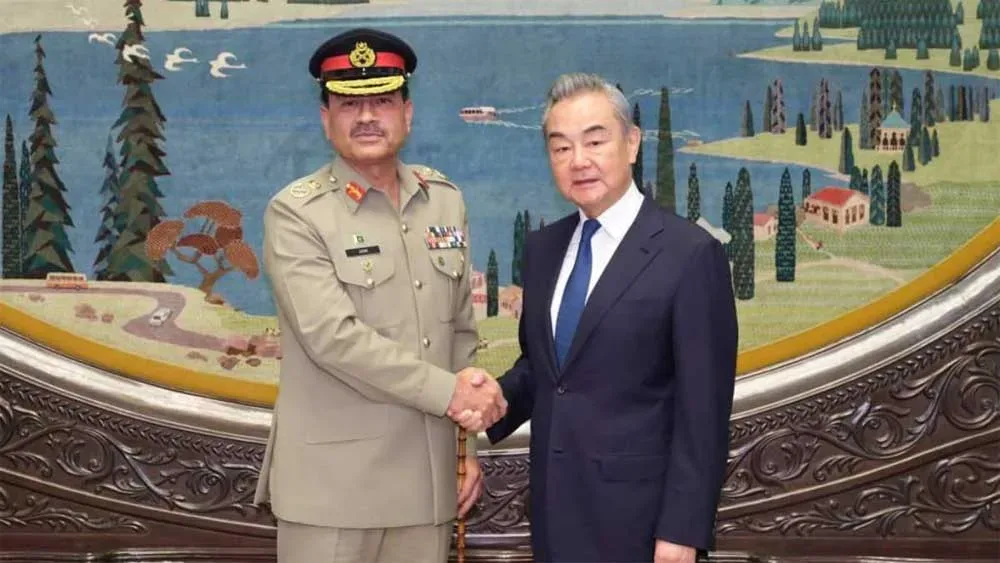
On April 27, Munir met Wang Yi, then Director of the Office of the Central Commission for Foreign Affairs, in Beijing.
Wang Yi described the Pakistan Army as a defender of Pakistan's national security and an important guardian of the China-Pakistan friendship.
He reaffirmed China's support for Pakistan's sovereignty, independence, territorial integrity, stability and development.
Munir, in turn, emphasised that strengthening the all-weather strategic cooperative partnership with China remained a cornerstone of Pakistan's foreign policy.
The timing was significant.
Pakistan was experiencing severe economic difficulties, renewed terrorism and intense political polarisation.
China's support therefore carried economic, diplomatic and strategic importance.
The discussions also reflected a shared desire to improve the quality and effectiveness of CPEC projects as the initiative entered its second decade.
For Munir, the visit established direct contact with senior Chinese political and military leadership at an early stage of his command.
03 / SECURITY
From CPEC construction to CPEC protection
As CPEC expanded, protecting Chinese personnel and projects became an increasingly difficult task.
Pakistan had established dedicated security arrangements for Chinese workers and infrastructure, including military and civilian security formations.
Yet attacks continued.
The challenge was complex because CPEC projects were geographically dispersed.
Some were located in major cities.
Others were situated in remote mountainous regions, strategically sensitive areas or locations affected by militancy.
Protecting engineers working on a hydropower project in northern Pakistan required different arrangements from securing Chinese personnel in Karachi or safeguarding infrastructure in Balochistan.
The threat also came from different organisations.
Militant groups operating along the Afghan frontier posed one kind of danger.
Baloch separatist armed organisations presented another.
These groups differed in ideology, objectives and methods, but attacks on Chinese nationals had a common strategic consequence: they threatened Pakistan's credibility as a secure destination for Chinese investment.
The problem therefore extended beyond individual terrorist incidents.
Each attack raised questions about Pakistan's ability to fulfil the security commitments underpinning its economic relationship with Beijing.
The Bisham tragedy
One of the gravest incidents occurred on March 26, 2024.
A suicide bomber attacked a vehicle carrying Chinese engineers and workers near Bisham in Khyber Pakhtunkhwa.
Five Chinese nationals and their Pakistani driver were killed.
The victims were associated with the Dasu Hydropower Project.
The attack shocked both countries.
China strongly condemned the killings and demanded a thorough investigation, punishment of those responsible and stronger protection for its nationals.
Pakistan's government and military leadership condemned the attack and pledged to bring the perpetrators to justice.
For Munir, the incident highlighted the inseparable relationship between counterterrorism and economic development.
Pakistan could negotiate infrastructure projects worth billions of dollars.
It could offer investment incentives.
It could promise administrative facilitation.
But if foreign engineers could not work safely, those promises would face serious practical limitations.
The Bisham attack therefore became a warning that security failures could undermine economic diplomacy.
Karachi airport attack: another serious setback
Only months later, another deadly attack intensified Chinese concerns.
On October 6, 2024, a convoy carrying Chinese personnel associated with the Port Qasim Electric Power Company was attacked near Karachi's Jinnah International Airport.
Two Chinese nationals were killed, while another was injured. Pakistani casualties were also reported.
The Balochistan Liberation Army claimed responsibility.
China responded with strong condemnation and renewed demands for comprehensive protection of Chinese personnel, institutions and projects.
Beijing called for security loopholes to be addressed and for more targeted protective measures.
The attack was particularly troubling because it occurred in Karachi, Pakistan's commercial and financial centre.
The city was not a remote conflict zone.
It was the country's principal business hub, home to major ports, industries, financial institutions and international commercial activity.
The attack demonstrated that the threat to Chinese nationals could extend well beyond traditional insurgency-affected districts.
For Pakistan, this created an urgent challenge: security arrangements had to evolve as militant tactics evolved.
04 / COORDINATION
A difficult but necessary conversation
The repeated attacks created pressure within the Pakistan-China relationship.
Beijing wanted effective protection.
Islamabad insisted that it was committed to safeguarding Chinese citizens and projects.
But declarations alone could not resolve the problem.
More effective intelligence-sharing was required.
Coordination among military, police and civilian security agencies had to improve.
Transport routes and project sites needed risk assessments.
Local security arrangements required stronger oversight.
And the wider terrorist networks responsible for planning, financing and facilitating attacks had to be dismantled.
This was where Munir's responsibilities as Army Chief became particularly important.
He could coordinate military counterterrorism capabilities, strengthen institutional exchanges with Chinese defence authorities and support the security commitments made by Pakistan's civilian government.
Yet effective protection also depended on provincial police, intelligence coordination, administrative competence and cooperation with Chinese companies.
The challenge required a national response rather than reliance on any single institution.
The 2024 leadership engagements
The relationship gained renewed momentum during Prime Minister Shehbaz Sharif's visit to China in June 2024.
General Asim Munir accompanied the Pakistani delegation, reflecting the importance attached to the military and security dimensions of bilateral cooperation.
The visit included engagements with President Xi Jinping and other senior Chinese leaders.
Both sides emphasised their commitment to expanding CPEC, improving economic cooperation and strengthening protection for Chinese personnel.
Later that year, Chinese Premier Li Qiang visited Pakistan in October.
The visit came only days after the Karachi airport attack.
In their joint statement, Pakistan and China reaffirmed their determination to combat terrorism, strengthen security cooperation and bring those responsible for attacks on Chinese citizens to justice.
These engagements demonstrated that the security challenge had not weakened the political determination of the two governments to maintain their partnership.
But they also made clear that future cooperation would require measurable improvements in protection and implementation.
05 / CPEC 2.0
July 2025: A new phase of military diplomacy
By July 2025, Asim Munir had been elevated to the rank of Field Marshal following the India-Pakistan confrontation of May that year.
His subsequent official visit to China was therefore particularly significant.
On July 25, Pakistani military authorities announced that Field Marshal Munir had held a series of high-level meetings in Beijing.
He met Chinese Vice President Han Zheng and Foreign Minister Wang Yi.
He also held discussions with senior People's Liberation Army leadership, including General Zhang Youxia, Vice Chairman of China's Central Military Commission.
At PLA Army Headquarters, Munir received a guard of honour.
The discussions covered defence cooperation, counterterrorism, joint training, defence modernisation and coordination against emerging security threats.
They also addressed CPEC connectivity and wider regional stability.
The visit illustrated the institutional depth of the relationship.
Pakistan-China ties did not depend solely on exchanges between prime ministers and presidents.
They were reinforced through direct communication between their military establishments.
For Munir, this was particularly important because China's defence relationship with Pakistan was intertwined with the protection of strategic infrastructure and regional security interests.
CPEC 2.0: Beyond roads and power plants
The next phase of CPEC presented a different set of ambitions.
The original corridor had concentrated heavily on energy, transport infrastructure and connectivity.
CPEC 2.0 sought to broaden cooperation towards industrial development, agriculture, technology, innovation, employment and export-oriented growth.
This was a necessary evolution.
Infrastructure can provide the foundations for economic development, but roads and power plants alone cannot guarantee prosperity.
Pakistan needs competitive industries.
It needs skilled workers.
It needs technology transfer.
It needs higher-value exports.
It needs efficient agriculture and modern logistics.
It also needs to convert infrastructure investment into sustained private-sector activity.
The success of CPEC's second phase would therefore depend upon both countries moving beyond project announcements towards commercially viable investments.
Security would remain essential, but so would Pakistan's domestic economic reforms.
06 / 2026 EXCHANGES
The 75th anniversary: A renewed commitment
In May 2026, Pakistan and China marked the 75th anniversary of diplomatic relations.
Prime Minister Shehbaz Sharif visited China from May 23 to 26, accompanied by senior officials, including Field Marshal Asim Munir, who was serving as Chief of Defence Forces and Chief of Army Staff.
The Prime Minister met President Xi Jinping, while Munir separately held discussions with Wang Yi.
The visit produced an extensive joint statement reaffirming the strategic partnership.
Both governments agreed to advance CPEC 2.0, strengthen industrial and technological cooperation, improve regional connectivity and pursue a closer security partnership.
The statement also emphasised the protection of Chinese personnel, projects and institutions in Pakistan.
Particularly significant was the agreement to work towards a China-Pakistan Security Partnership, alongside continued counterterrorism and military cooperation.
The two countries also welcomed further dialogue concerning Afghanistan, recognising that regional instability and militant networks could threaten their shared interests.
For Munir, the visit connected several dimensions of his evolving role: military leadership, strategic diplomacy, counterterrorism and economic security.
November 2026: The relationship continues to deepen
The latest evidence of sustained high-level engagement came on November 2, 2026.
Liu Haixing, Minister of the International Department of the Communist Party of China's Central Committee, met Field Marshal Asim Munir at General Headquarters in Rawalpindi.
According to the military's statement, the discussions covered regional and international security developments and bilateral relations.
Both sides reaffirmed their commitment to strengthening the all-weather strategic cooperative partnership.
Munir emphasised the historic relationship and the importance of stronger institutional connections and continued high-level exchanges.
The meeting was another reminder that the relationship was not limited to occasional state visits.
It involved regular engagement across political, military and diplomatic institutions.
07 / THE REAL TEST
The real test of an iron brotherhood
Pakistan-China relations have survived many difficult periods.
They have endured regional crises, international realignments and changing economic conditions.
But the next phase will be judged increasingly by practical results.
Can Pakistan provide dependable security for Chinese citizens?
Can CPEC projects be completed efficiently?
Can special economic zones attract productive investment?
Can Chinese technology and industrial experience help Pakistan expand exports and employment?
Can the two countries improve regional connectivity while managing tensions with Afghanistan and other neighbours?
These questions matter more than ceremonial declarations.
For Munir, the responsibility is particularly clear in the security domain.
The military can help protect strategic projects, strengthen counterterrorism cooperation and maintain close defence ties with Beijing.
But successful economic transformation requires civilian leadership, effective institutions, transparent agreements and sustained policy reform.
Pakistan's friendship with China is a strategic asset.
Turning that asset into broad-based prosperity remains a national responsibility.
From Beijing to Riyadh
Asim Munir's engagements with Chinese leadership demonstrated how his responsibilities had expanded beyond conventional military command.
He was now participating in a network of strategic relationships connecting Pakistan's defence, economy and regional diplomacy.
China represented one of the most important pillars of that network.
But another relationship carried equally profound significance.
Saudi Arabia.
The Kingdom had long been a close partner of Pakistan, with cooperation spanning defence, religion, economic assistance, investment and regional diplomacy.
Munir's professional career had included service in Saudi Arabia, giving him an earlier connection with the country.
As Army Chief and later Field Marshal, his engagements with Saudi leadership would acquire greater strategic importance.
The relationship would also raise wider questions about Pakistan's role in Gulf security, regional diplomacy and economic cooperation.
Having examined the China-Pakistan partnership, the next chapter turns towards Riyadh and the Gulf.
It is there that another dimension of Asim Munir's journey-from military commander to an increasingly visible participant in international strategic diplomacy-comes into focus. (To be Continued)
THE CENTRAL TEST
“Pakistan's friendship with China is a strategic asset. Turning that asset into broad-based prosperity remains a national responsibility.”
From the article · Manzar Naqvi · The Financial Daily