That distinction would become increasingly important in subsequent years.
Before that economic role fully emerged, however, Pakistan's political crisis was about to explode.
A widening political divide
The confrontation between former Prime Minister Imran Khan's PTI and the coalition government continued after Munir became Army Chief.
Khan remained one of Pakistan's most popular political figures and continued demanding early elections.
At the same time, his criticism of senior military officials became increasingly direct.
PTI maintained that the establishment had moved against Khan politically. The military rejected accusations that it was pursuing a political campaign against him and publicly maintained that the armed forces should remain outside partisan politics.
The disagreement was no longer simply between a government and an opposition party.
Public debate increasingly involved the military establishment itself.
For a new Army Chief who had inherited an institution already under intense political scrutiny, this represented an exceptionally difficult environment.
Then came May 9.
The arrest that ignited nationwide unrest
On May 9, 2023, Imran Khan was arrested at the Islamabad High Court in connection with the Al-Qadir Trust case.
His arrest triggered protests across Pakistan.
What followed went considerably beyond ordinary political demonstrations.
Violence erupted in several cities. Government property was damaged. Vehicles and buildings were attacked or set ablaze.
Most significantly for the military, protesters entered or attacked military sites.
At General Headquarters in Rawalpindi, demonstrators breached an entrance.
In Lahore, protesters entered and vandalised the residence of the Corps Commander, widely known afterwards as Jinnah House, and the building was set on fire.
Other military and state installations were targeted elsewhere.
At least eight people were killed amid the unrest, according to subsequent reporting, while large numbers were arrested.
Pakistan had experienced political violence before.
But attacks on prominent military installations carried a different institutional significance.
For General Asim Munir, who had been Army Chief for less than six months, May 9 became the most serious internal challenge of his command to that point.
The military's response
The Army reacted strongly.
ISPR described May 9 as a dark chapter and subsequently warned that further attacks on military installations would not be tolerated.
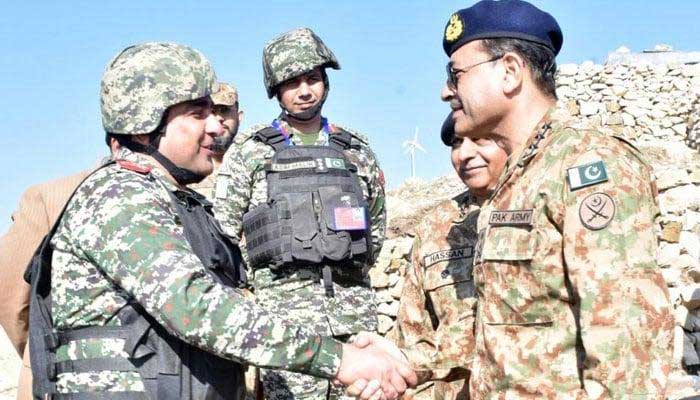
General Munir visited Peshawar Corps Headquarters on May 13 and addressed officers about the evolving national-security environment. He also highlighted what the military described as challenges posed by information warfare and attempts to create divisions between the armed forces and the public.
Two days later, on May 15, Munir presided over a Special Corps Commanders Conference at GHQ.
The military leadership condemned the attacks on military and civilian installations and resolved that those responsible would be brought to justice under applicable Pakistani laws, including the Pakistan Army Act and Official Secrets Act.
The civilian leadership subsequently endorsed the decision at a National Security Committee meeting chaired by Prime Minister Shehbaz Sharif.
The proposed use of military laws against civilians generated substantial controversy.
Human-rights organisations and legal critics raised concerns about civilians being tried in military courts, arguing that such proceedings raised serious questions of due process and civilian judicial authority.
The government and military, however, maintained that attacks on sensitive defence installations constituted exceptionally serious offences and required accountability under applicable law.
This legal and constitutional debate would continue well beyond 2023.
Accountability-and a political dispute that did not disappear
Responsibility for May 9 subsequently became one of Pakistan's most bitter political disputes.
The government and military accused individuals associated with PTI of involvement in attacks on state and military installations.
Imran Khan and PTI rejected accusations that their leadership had orchestrated the violence and repeatedly described subsequent cases and the crackdown against the party as politically motivated.
Khan was later charged with incitement relating to the unrest and denied wrongdoing.
Subsequent court proceedings resulted in convictions of a number of people in cases arising from the violence, while other defendants were acquitted or continued to contest charges.
The competing narratives remain important.
May 9 is therefore best understood through what can be established directly: violent protests followed Khan's arrest; military and state installations were attacked; people were killed and arrested; the military and government initiated extensive legal proceedings; and PTI disputed allegations that its leadership had planned or directed the violence.
A defining test of command
For Asim Munir, May 9 represented something beyond another episode of political unrest.
The institution he commanded had itself become a physical target.
His response emphasised institutional discipline, protection of military installations, remembrance of fallen soldiers and legal accountability.
During subsequent visits and commanders' meetings, Munir repeatedly stated that attacks of this nature would not be allowed to recur.
The crisis also revealed a wider challenge confronting Pakistan.
An army can protect borders.
Security forces can conduct counterterrorism operations.
The state can prosecute criminal acts.
But political polarisation ultimately cannot be resolved by military means alone.
It requires functioning political institutions, constitutional processes, dialogue and public confidence in the rule of law.
That reality made Munir's December 2022 call for national consensus appear increasingly significant.
Pakistan needed security.
It needed political stability.
And it desperately needed economic recovery.
Beyond May 9
The events of May 9 would cast a long shadow over Pakistani politics and civil-military relations.
But for General Munir, command could not remain consumed by a single crisis.
Terrorism continued.
Border security remained demanding.
Pakistan's economy required investment and confidence.
Relations with major international partners needed attention.
The Army Chief would increasingly appear not only in military-security discussions but also in meetings connected with economic stability, foreign investment and Pakistan's relationships with Saudi Arabia, the United Arab Emirates, China and the United States.
This would open another important-and sometimes debated-dimension of his tenure.
Could national security be strengthened without economic security?
For Munir, the two increasingly appeared interconnected.
That thinking would soon become visible in Pakistan's efforts to attract investment and in the creation of the Special Investment Facilitation Council.
The soldier who had begun his command confronting terrorism and political turmoil was about to enter another battlefield: Pakistan's struggle for economic stability.