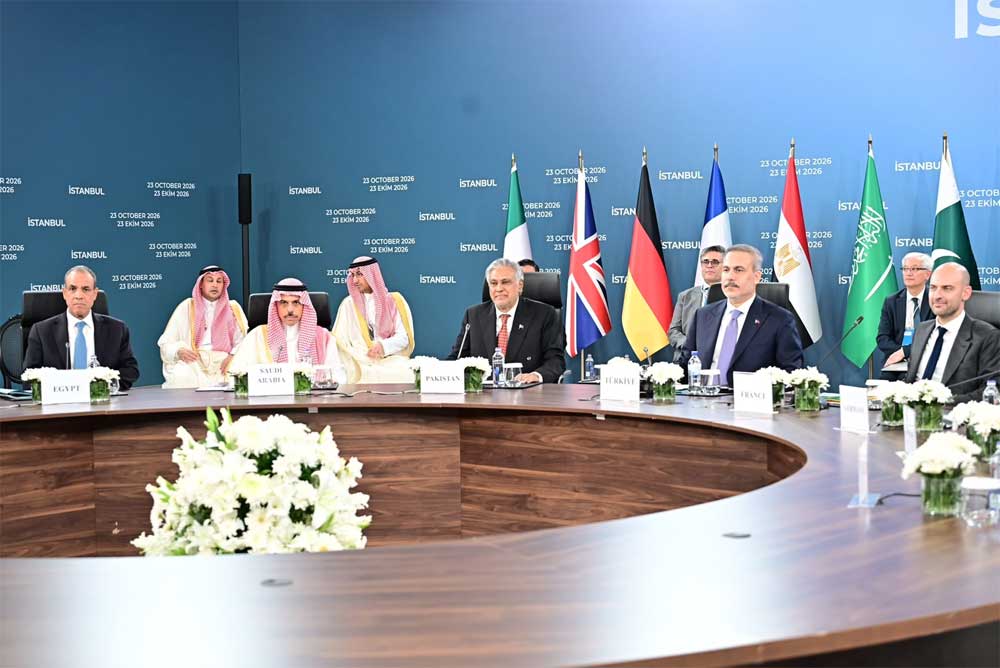
ISLAMABAD: Foreign ministers from the Regional Four (R4) - Turkiye, Egypt, Pakistan and Saudi Arabia - along with their counterparts from France, Germany, Italy and the United Kingdom, on Saturday reaffirmed their commitment to intensify diplomatic efforts for peace, stability and de-escalation across the region and beyond.
The ministers met in Istanbul, Turkiye, where they reviewed a wide range of regional and international issues with potentially far-reaching security, economic and trade implications.
According to a joint press release shared by the Foreign Office spokesperson, the ministers discussed the US/Israel-Iran conflict, the Israeli-Palestinian dispute and the need for a negotiated two-state solution.
They also reviewed the Houthi militia attacks against Saudi Arabia and the Government of Yemen, threats to the safety and freedom of navigation, rising tensions in the Strait of Hormuz and Bab el-Mandeb, and developments in the Black Sea.
The ministers stressed that regional conflicts should be addressed through dialogue, diplomacy and de-escalation rather than through further confrontation.
They reaffirmed their commitment to contributing to diplomatic initiatives aimed at promoting peace and stability while also addressing the broader security, economic and trade consequences of continuing regional tensions.
In line with relevant United Nations resolutions, the foreign ministers emphasised the importance of finding durable and negotiated settlements to all outstanding conflicts.
Particular attention was given to the Israeli-Palestinian conflict, with the ministers underscoring the need for a negotiated two-state solution as a basis for lasting peace.
The meeting also highlighted growing concerns over maritime security, especially in strategically important waterways including the Strait of Hormuz and Bab el-Mandeb, through which a significant share of global energy supplies and commercial shipping passes. The ministers agreed that safeguarding freedom of navigation and preventing further escalation in these areas remained essential for regional and international economic stability.
They also exchanged views on wider international developments, including tensions in the Black Sea, and acknowledged the interconnected nature of regional security crises and their potential impact on global trade and economic confidence.
Concluding the meeting, the ministers agreed to continue consultations in the same format with the objective of preventing conflicts, strengthening diplomatic coordination and advancing peace and stability in the region.
The Istanbul meeting reflected a broader effort by regional and European powers to maintain dialogue at a time of heightened geopolitical tensions and to seek negotiated solutions to disputes threatening regional and global security.