The party presented the movement primarily as a campaign for early elections and against the coalition government.
Government figures, however, publicly argued that its timing was connected to the approaching change of command in the Army.
Then came the attack on Imran Khan's convoy at Wazirabad on November 3, in which the former prime minister was wounded.
The political environment became even more volatile.
Despite his injuries, Khan continued addressing supporters remotely, while PTI's mobilisation continued.
The country was therefore approaching the appointment of its next Army Chief amid street politics, bitter accusations between government and opposition, institutional tensions and widespread speculation.
Yet the officer whose name featured prominently in all this discussion remained publicly silent.
Asim Munir did not campaign for the position.
He did not respond to political commentary.
He remained a serving lieutenant general performing his duties as Quartermaster General.
The decision rested elsewhere.
Six names reach the government
On November 23, 2022, the process entered its decisive phase.
General Headquarters forwarded a summary containing the names of the six senior-most lieutenant generals to the Ministry of Defence for the appointments of Chief of Army Staff and Chairman Joint Chiefs of Staff Committee.
Asim Munir was at the top of the seniority list.
Prime Minister Shehbaz Sharif consulted his coalition partners. The allied parties publicly expressed confidence in the prime minister to make the decision in accordance with his constitutional authority.
The following day, the uncertainty ended.
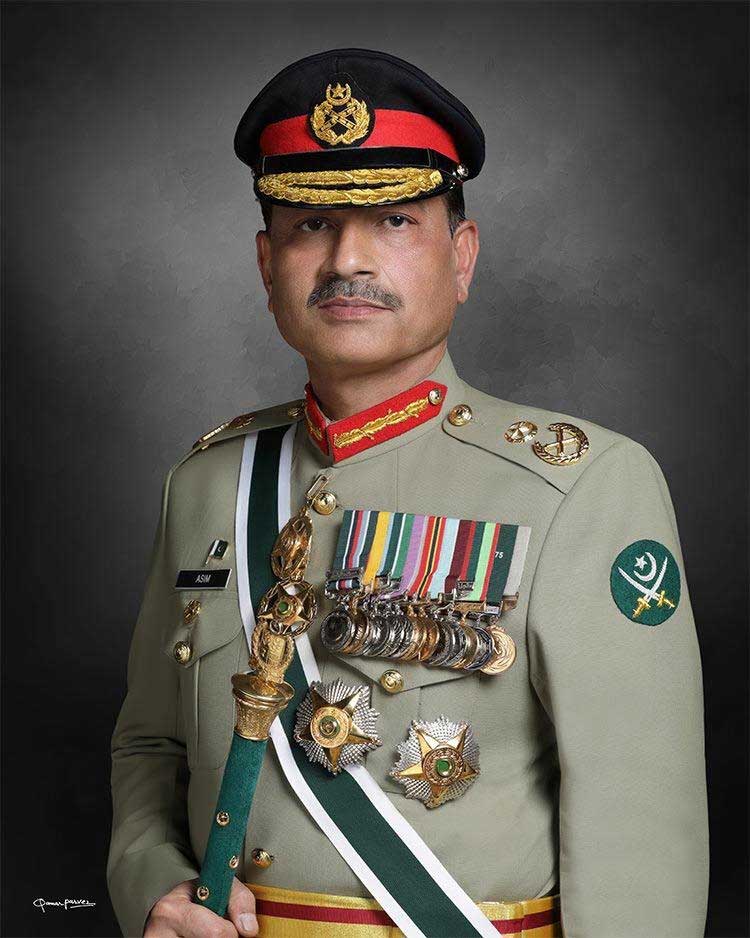
Prime Minister Shehbaz Sharif selected Lieutenant General Syed Asim Munir as Chief of Army Staff and Lieutenant General Sahir Shamshad Mirza as Chairman Joint Chiefs of Staff Committee.
The principle of seniority had prevailed in the selection of the Army Chief.
But one constitutional step remained.
The summary had to go to President Dr Arif Alvi.
And President Alvi belonged to PTI.
The President travels to Lahore
This produced one of the most extraordinary scenes of the entire appointment process.
Before acting on the prime minister's advice, President Arif Alvi travelled to Lahore and met Imran Khan.
The meeting reportedly lasted approximately 45 minutes.
The constitutional position, however, was clear: under Article 243 of Pakistan's Constitution, the President appoints the services chiefs on the advice of the Prime Minister.
Imran Khan held no constitutional role in making the appointment.
Nevertheless, because Alvi had been elected president as a PTI candidate and Khan remained chairman of the party, the Lahore consultation attracted enormous attention.
Would the President sign the summary?
Would he return it for reconsideration?
Would there be a delay?
Could Pakistan be pushed into another institutional confrontation?
For several hours, speculation intensified.
But the feared confrontation did not materialise.
President Alvi returned to Islamabad and approved the appointments.
On November 24, 2022, the Presidency formally announced that Lieutenant General Syed Asim Munir had been promoted to the rank of General with immediate effect and appointed Chief of Army Staff with effect from November 29.
The same announcement confirmed General Sahir Shamshad Mirza as Chairman Joint Chiefs of Staff Committee.
A political and institutional drama that had occupied Pakistan for weeks had ended through the constitutional process.
An unusual technical hurdle overcome
Munir's approaching retirement date had generated considerable discussion before his selection.
Because his service as a lieutenant general was due to conclude before the date on which he would formally assume command, his promotion to four-star general was made effective immediately.
This resolved the technical issue.
The man whose eligibility had been the subject of repeated speculation was now officially General Syed Asim Munir, Pakistan's Chief of Army Staff-designate.
His appointment carried another historical distinction.
He became the first Pakistan Army Chief to have entered commissioned service through the Officers Training School at Mangla rather than the Pakistan Military Academy's traditional long-course route.
The Sword of Honour recipient of the 17th Officers Training Course had reached the summit of his profession.
From controversy to constitutional appointment
The significance of November 24 extended beyond one officer's promotion.
Pakistan had spent months experiencing political instability. The Army itself had become the subject of unusually intense political criticism and debate. General Bajwa acknowledged shortly before retirement that the military's involvement in politics over previous decades had exposed the institution to criticism, while saying that the Army had decided to remain outside politics.
The incoming Chief therefore faced a challenge greater than merely commanding troops.
He would inherit an institution confronting questions about its relationship with politics, while Pakistan faced terrorism, economic instability, tensions on its borders and deep internal polarisation.
For Munir personally, the appointment represented a remarkable reversal of circumstances.
In June 2019, he had left the ISI after one of the shortest tenures of any director general.
In November 2022, the same officer was selected to command the entire Pakistan Army.
The government described the decision in terms of seniority and merit.
PTI, after the appointments were announced, congratulated the new military leadership.
The immediate confrontation many had feared did not occur.
November 29: the baton changes hands
Five days after the presidential approval, the transition became complete.
On November 29, 2022, at General Headquarters in Rawalpindi, outgoing Army Chief General Qamar Javed Bajwa handed the command baton to General Syed Asim Munir.
The ceremony was rich in military tradition.
For Asim Munir, however, the moment represented something much larger than ceremonial succession.
The young officer commissioned into the 23rd Frontier Force Regiment in 1986 was now commanding the Pakistan Army.
The former DG Military Intelligence had become Army Chief.
The former DG ISI whose tenure had ended unexpectedly had become Army Chief.
The corps commander and Quartermaster General had become Army Chief.
The professional journey had reached its highest conventional military command.
But the circumstances in which Munir assumed office ensured that there would be no quiet beginning.
Pakistan was politically divided.
Economic pressures were intensifying.
Terrorism was resurging.
Relations with Afghanistan were becoming increasingly difficult.
The Army faced questions about its role in politics.
And the confrontation between PTI and the state was far from over.
Within months, that confrontation would reach a level few could have anticipated.
On May 9, 2023, following Imran Khan's arrest, violent protests erupted across Pakistan. Military installations and symbols-including the Lahore Corps Commander's residence-were attacked.
For the new Army Chief, the crisis would become one of the first defining tests of his command.
The challenges surrounding Asim Munir's appointment had ended.
The challenges of actually commanding Pakistan's Army had only begun.