
Among the most promising opportunities emerging from Sindh Chief Minister Syed Murad Ali Shah's week-long visit to China is the possibility of transforming Sindh into a centre for electric vehicle manufacturing, green public transport and modern automotive technology. China's remarkable progress in electric mobility offers an important lesson: the transition from conventional vehicles to electric transport is not merely an environmental initiative, but a major industrial and economic opportunity.
For Sindh, which faces growing urban pollution, rising transport demands, expensive imported fuel and limited industrial diversification, electric mobility could become an important component of a new development strategy.
During the China mission, Murad Ali Shah was accompanied by Senior Minister Sharjeel Inam Memon, members of the provincial cabinet, senior officials and Wang Zhaoxiang, Secretary to the Consul General at the Chinese Consulate in Karachi. Their engagements in Hubei and Shanghai explored cooperation in industrial manufacturing, technology transfer, infrastructure and sustainable transport.
The investment proposals prepared for the visit identified electric vehicle assembly, electric motorcycles, charging infrastructure and possible cooperation with Chinese automobile manufacturers, including Geely, Zeekr and AIMA. The Dhabeji Special Economic Zone was highlighted as a potential location for automotive manufacturing and assembly.
The opportunity is significant. But Sindh must think beyond simply importing electric vehicles. The objective should be to develop a complete electric mobility ecosystem that creates factories, supports local industries, trains young people and provides affordable transport.
China's electric vehicle transformation
China has emerged as a global leader in electric mobility through an approach that combines industrial policy, technological innovation, battery manufacturing, charging infrastructure and large-scale domestic production.
Its achievements demonstrate that electric vehicles cannot succeed through vehicle imports alone. Their expansion requires a supporting industrial system involving batteries, electronic components, electric motors, software, charging networks, maintenance facilities and skilled workers.
Chinese companies have developed extensive manufacturing and supply-chain capabilities, enabling them to compete internationally in electric cars, buses and two-wheelers.
This experience offers important lessons for Pakistan.
Sindh should not expect to reproduce China's automotive industry overnight. However, it can begin by developing selected areas where local manufacturing, technology transfer and market demand can support long-term investment.
The first objective should be to establish a realistic pathway from assembly to progressively higher levels of local production.
Dhabeji could become an automotive hub
The Dhabeji Special Economic Zone offers an important opportunity to attract Chinese automotive investment.
Its proximity to Karachi and Port Qasim, access to industrial services and potential export connectivity make it a suitable location to assess for electric vehicle manufacturing.
During the China mission, proposals involving Geely, Zeekr and electric two-wheeler manufacturer AIMA were among the automotive opportunities identified for cooperation.
These proposals must now be followed by detailed feasibility studies, commercial negotiations and clear implementation plans.
Dhabeji should aim to attract not only vehicle assemblers but also supporting industries producing wiring, plastic components, tyres, electronic systems, charging equipment and other automotive parts.
Initially, some components may have to be imported. However, the longer-term objective should be to develop local suppliers capable of meeting international quality standards.
This would provide opportunities for existing Pakistani engineering companies and small and medium-sized manufacturers.
A single major assembly facility could create demand for a wider network of suppliers, maintenance companies, logistics providers and technical services.
That is how an industrial cluster begins to develop.
Sharjeel Memon's transport engagements
An important practical dimension of the visit came through Senior Minister Sharjeel Inam Memon's meetings with Chinese bus manufacturers in Shanghai.
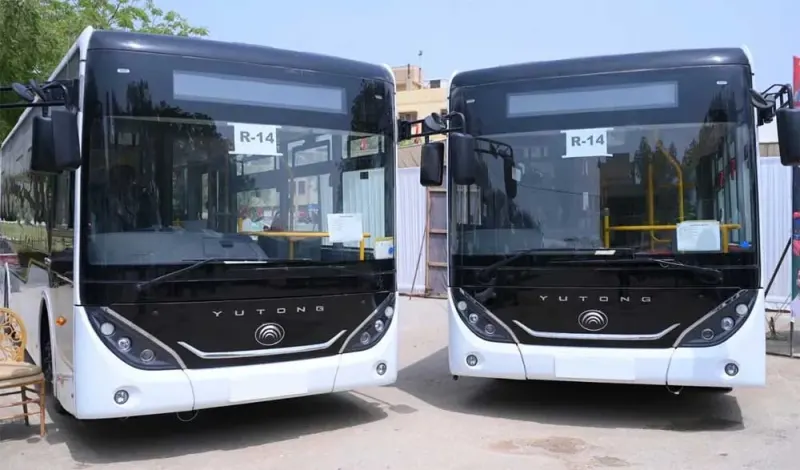
As Sindh's Minister for Transport and Mass Transit, Sharjeel met senior executives of Yutong and Higer to discuss modernising public transport, introducing electric buses and advancing plans for additional buses for Karachi.
During his meeting with Yutong Chief Executive Officer Robin Shen, the company offered cooperation in expanding electric bus services in Sindh. Discussions with Higer Vice President Liu Zheng addressed the supply of double-decker buses and related transport development.
These engagements complement the Chief Minister's broader investment programme by connecting Chinese industrial expertise directly with Sindh's public transport requirements.
Karachi urgently needs a more reliable, affordable and environmentally sustainable transport system. Electric buses could help reduce roadside emissions while improving daily travel for thousands of commuters.
But vehicles alone cannot solve the transport crisis. Routes, depots, charging facilities, maintenance systems and connections with existing rapid-transit networks must be planned together.
Electric buses can transform urban mobility
Sindh has already initiated steps towards introducing electric buses and modernising public transport.
The provincial government's proposed People's Green Transport Project envisages 500 electric buses for Karachi and Hyderabad, alongside charging infrastructure, depots, passenger shelters and intelligent transport systems.
If successfully implemented, such an initiative could significantly improve public transport while supporting the transition towards cleaner urban mobility.
Karachi's growing population requires a transport strategy capable of reducing dependence on private vehicles and motorcycles.
Electric buses could serve major commercial, educational and residential corridors while providing more comfortable and predictable travel.
However, the success of these projects must be assessed through reliable service, affordable fares, passenger numbers, operating costs and public satisfaction-not simply the number of buses purchased.
China's experience demonstrates that modern transport systems succeed when technology, infrastructure and service management are integrated.
Charging infrastructure is essential
One of the biggest challenges facing electric mobility in Pakistan is the availability of dependable charging infrastructure.
Consumers may hesitate to purchase electric vehicles if convenient charging facilities are unavailable.
Sindh therefore needs a coordinated strategy involving charging stations along major roads, commercial centres, industrial zones and transport corridors.
Electric buses require charging depots with adequate power capacity, while electric motorcycles and smaller vehicles may benefit from a combination of home charging, public charging and battery-swapping systems.
This transition also presents opportunities for private investment.
Charging infrastructure can become a new business sector involving electricity distribution, equipment manufacturing, software, maintenance and payment services.
But the government must establish appropriate technical and safety standards, transparent pricing and reliable electricity arrangements.
Without these foundations, electric mobility will struggle to expand beyond a limited market.
Electric motorcycles and affordable mobility
While electric cars attract public attention, electric motorcycles may offer a more immediate opportunity for Pakistan.
Motorcycles remain among the most widely used forms of personal transport, particularly for students, salaried workers, delivery riders and small businesses.
Electric two-wheelers could help reduce fuel expenditure and local air pollution, provided their purchase prices, battery performance and maintenance costs remain affordable.
Cooperation with Chinese manufacturers such as AIMA could support assembly, technical training and the development of local components.
Sindh could also explore financing arrangements and targeted incentives that make electric motorcycles accessible to ordinary citizens.
However, product quality and battery safety must remain essential considerations.
A successful electric mobility policy should benefit middle- and lower-income households rather than remain confined to expensive vehicles.
Local skills and technology transfer
Electric mobility creates opportunities for an entirely new generation of technical workers.
Sindh will require trained specialists in battery systems, electric motors, automotive electronics, charging equipment, software diagnostics and vehicle maintenance.
Technical institutes, engineering universities and vocational training organisations should begin preparing for these requirements.
Chinese manufacturers could contribute through apprenticeships, joint training facilities and technology-transfer programmes.
The province should also encourage partnerships between universities and industry to develop research capabilities in battery management, energy efficiency and automotive technology.
The goal must be to ensure that young Sindhis participate in the growth of electric mobility as engineers, technicians, manufacturers and entrepreneurs.
Without local skills, electric vehicle expansion could increase dependence on imported expertise rather than strengthen domestic industry.
Green mobility requires green energy
Electric vehicles can reduce exhaust emissions in cities, but their overall environmental benefits depend partly on how electricity is generated.
Sindh possesses considerable wind and solar energy potential, particularly in the Jhimpir and Gharo corridors.
This creates an opportunity to connect electric transport with renewable-energy development.
Solar-powered charging facilities, renewable electricity supply arrangements and battery storage could gradually support cleaner mobility.
Battery recycling and responsible disposal will also become increasingly important as electric vehicles expand.
Sindh should establish environmental safeguards early rather than allowing future waste-management problems to emerge unchecked.
A genuinely green transport strategy must consider the entire life cycle of vehicles and batteries.
Turning the China vision into reality
Murad Ali Shah's China visit has created an opportunity to connect investment diplomacy with industrial development and public transport reform.
Pakistan's national New Energy Vehicles Policy 2025-2030 also provides a broader framework for promoting electric mobility and local manufacturing.
Sindh should now develop a coordinated provincial roadmap covering electric vehicle assembly, public transport, charging infrastructure, workforce development and industrial investment.
The government should identify priority projects, establish realistic timelines and encourage Chinese investors to work with local manufacturers.
Every proposed partnership should be assessed according to investment commitments, local employment, technology transfer, affordability and long-term economic benefits.
The real lesson from China is that an electric vehicle revolution is not created by importing vehicles alone. It requires an industrial ecosystem supported by technology, infrastructure, skilled workers, investment and consistent policy.
If Sindh succeeds in applying these principles, Dhabeji could become a centre for automotive manufacturing, Karachi and Hyderabad could develop cleaner public transport, and thousands of young people could gain opportunities in emerging technical industries.
The Chief Minister's China mission has opened a promising door. The responsibility now lies with provincial institutions and private investors to translate that opportunity into a practical programme.
An electric Sindh should ultimately mean more than vehicles powered by batteries. It should mean cleaner cities, stronger industries, lower dependence on imported fuel, skilled employment and a more sustainable future for the province. (To be Continued)